
The 4G proxy farm cost depends on two separate bills: the hardware you buy once and the SIM data, power, and software you pay every month. Using a Raspberry Pi, Huawei E3372 HiLink dongles, and a powered USB layout, a practical planning budget is about $540 upfront and $195 per month for 10 active ports, before local taxes and shipping.
This guide gives you a bill of materials for 10-, 20-, and 50-dongle farms. It uses clear planning allowances rather than pretending that a dongle or SIM costs the same in every country. The USD figures are the main budget; the India figures are rounded planning equivalents at ₹95.06 per US dollar on 17 October 2026, not local quotes.
What you need to budget
You need one active SIM and one compatible LTE dongle for each proxy port. You also need a Linux host, powered USB hubs, cabling, cooling, and an internet connection for the host. The reference layout here is a Raspberry Pi with Huawei E3372 HiLink sticks, as described in the ProxyKite getting-started guide.
The calculations assume:
- A $35 planning allowance for each Huawei E3372 HiLink dongle. Check the actual model, firmware, seller, shipping, and local tax before ordering.
- One Raspberry Pi 5 4GB host, one powered hub, and one power-supply/cooling/cable group for each 10 dongles. This is a budgeting layout, not a claimed maximum capacity.
- A $10 per SIM monthly data budget for a light-to-moderate farm. Actual use depends on your traffic, carrier, plan, and country.
- $0.50 per active dongle per month for electricity in the USD model. This is a rounded allowance based on an assumed 3.5 W average per port and $0.20 per kWh.
- ProxyKite at exactly $9 per active dongle per month, billed monthly in USD by Paddle, with no per-GB software charge. Taxes are added at checkout.
The equipment prices are allowances. The ProxyKite licence is the product price. Keeping those categories separate makes it easier to replace an estimate with a real quote.
Step 1: One-off hardware cost
Why this matters: hardware is the capital expense, but a small accessory can decide whether a farm is tidy, powered correctly, and easy to expand.
Use the following base layout. The Raspberry Pi price is anchored to Raspberry Pi’s official 2025 price announcement and its April 2026 announcement of a further $25 increase for 4GB Raspberry Pi 4 and 5 variants. Treat the $95 figure as a current planning price and confirm the reseller basket before you pay.
| Component | Planning allowance | 10 dongles | 20 dongles | 50 dongles |
|---|---|---|---|---|
| Huawei E3372 HiLink dongles | $35 each | $350 | $700 | $1,750 |
| Raspberry Pi 5 4GB host | $95 × 1 per 10 | $95 | $190 | $475 |
| USB-C power supply | $15 × host | $15 | $30 | $75 |
| Powered USB hub | $45 × 1 per 10 | $45 | $90 | $225 |
| microSD, cooling, cables, case | $35 × host | $35 | $70 | $175 |
| One-off hardware total | $540 | $1,080 | $2,700 |
For reference, the official Raspberry Pi 5 pricing announcement put the 4GB board at $70 in December 2025, and the April 2026 update announced another $25 increase for 4GB variants. The official 27W USB-C power-supply page also explains why you should use a suitable supply when the Pi is driving USB peripherals.
At the ₹95.06 planning conversion, the same hardware allowances are approximately:
| Farm size | USD hardware allowance | India planning equivalent |
|---|---|---|
| 10 dongles | $540 | ₹51,300 |
| 20 dongles | $1,080 | ₹102,700 |
| 50 dongles | $2,700 | ₹256,700 |
These India numbers are currency conversions, not promises about Indian retail pricing. Shipping, GST, import costs, local stock, and a different hub or dongle price can move the total. Add a separate 10–15% buffer if a replacement must arrive quickly.
Do this: put the dongle count, host count, hub count, and real seller prices into a spreadsheet before you order.
Success looks like: every port has a dongle, every group has a powered hub and host, and the total includes cables, cooling, storage, and power supplies.
Step 2: Monthly costs: SIM data, power, licence
Why this matters: the monthly bill is driven by SIM usage and the number of active dongles, not by the size of the Raspberry Pi.
The baseline recurring model is:
| Monthly item | Per active dongle | 10 dongles | 20 dongles | 50 dongles |
|---|---|---|---|---|
| SIM data planning budget | $10 / ₹950 | $100 / ₹9,500 | $200 / ₹19,000 | $500 / ₹47,500 |
| ProxyKite licence | $9 / about ₹856 equivalent | $90 / about ₹8,600 | $180 / about ₹17,100 | $450 / about ₹42,800 |
| Electricity allowance | $0.50 / ₹25 | $5 / ₹250 | $10 / ₹500 | $25 / ₹1,250 |
| Monthly planning total | $19.50 / about ₹1,831 | $195 / about ₹18,300 | $390 / about ₹36,600 | $975 / about ₹91,500 |
The SIM line is a planning allowance, not an included ProxyKite service. Your own carrier data plan pays for the traffic. As one current India reference point, Jio lists a 50GB, 30-day data voucher for ₹359 on its official data-pack page. That does not tell you what your farm will use: a scraper, ad-verification workload, or media-heavy session can consume data at a different rate. Measure the first few lines and choose a plan whose terms allow your intended use.
For power, 3.5 W × 24 hours × 30 days is 2.52 kWh per active port each month. At $0.20 per kWh, that is about $0.50. For the India column, ₹25 per active port assumes ₹10 per kWh. Replace both rates with the tariff on your own bill; electricity varies more by location than this table suggests.
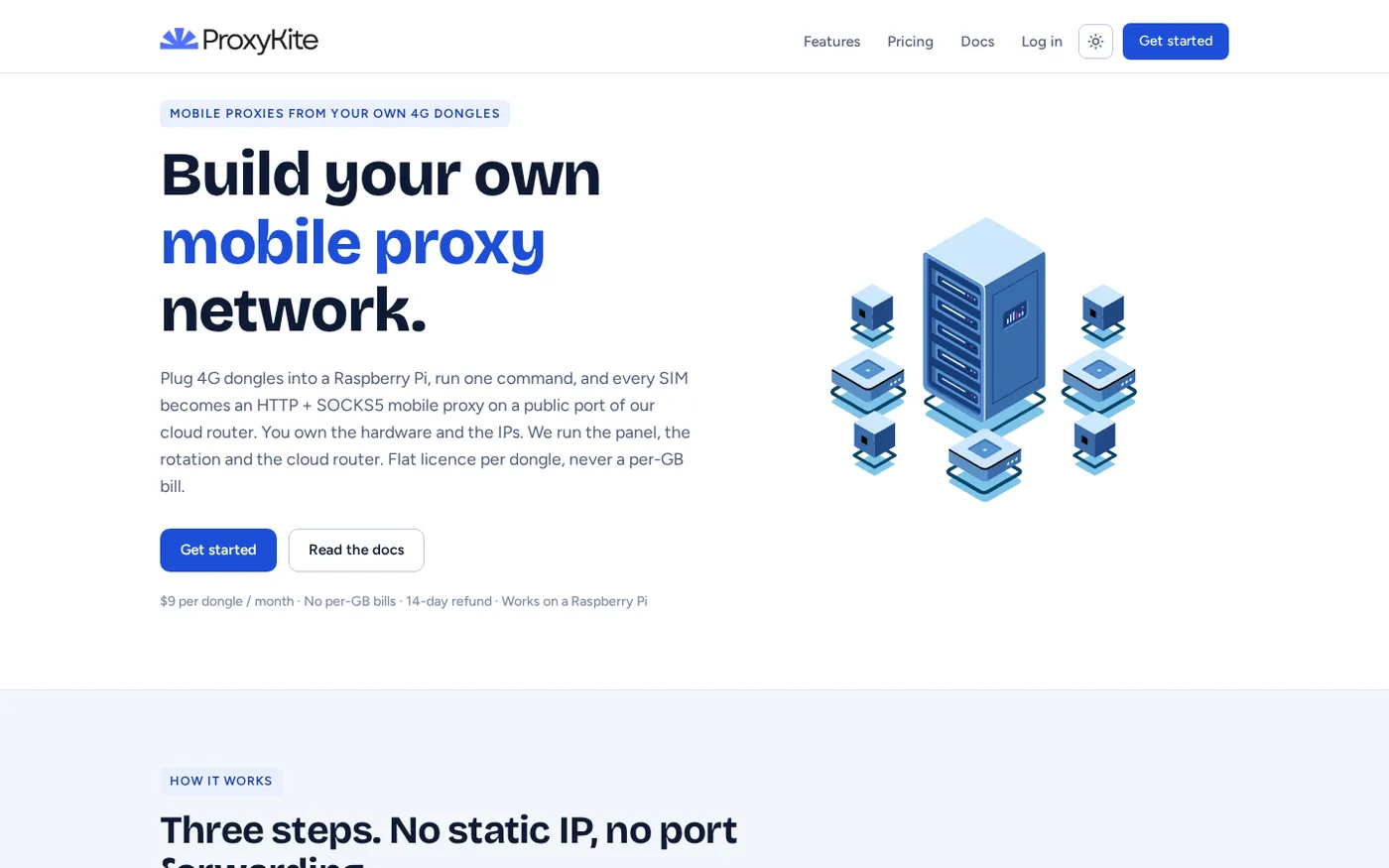
The screenshot below shows the live ProxyKite pricing card. The licence covers the cloud routing layer, so do not add a separate per-port VPS line to this baseline unless your own architecture needs one.
Do this: record SIM usage in GB, active dongles, and the wall-meter reading for one full billing period.
Success looks like: your recurring estimate has three visible lines—carrier data, software licence, and power—and you know which two can change with usage.
Step 3: Price a 10-dongle build
Why this matters: 10 ports are large enough to expose power, signal, and data assumptions without committing to a full rack.
The baseline 10-dongle farm looks like this:
| Cost period | USD | India planning equivalent |
|---|---|---|
| One-off hardware | $540 | ₹51,300 |
| Each month | $195 | about ₹18,300 |
| First month | $735 | about ₹69,600 |
| First 12 months, hardware included | $2,880 | about ₹270,900 |
The 10-port layout uses one host group: 10 dongles, one powered hub, one Raspberry Pi, and one set of cooling, storage, cables, and power supply. It gives you a clean baseline for measuring data per port.
For software, the standard calculation is 10 active dongles × $9 = $90 per month. Only active dongles are billed. If you keep a spare disconnected, keep it out of the active count until it is deployed.
Do this: start with the number of ports you can monitor and legally supply with SIMs. Record each SIM, dongle, signal location, and monthly data cap in a simple inventory sheet.
Success looks like: you can explain the $735 first-month total and identify the exact input that would change it before buying a second group.
Step 4: Price a 20-dongle build
Why this matters: at 20 ports, duplicated host groups are usually easier to budget and troubleshoot than one oversized USB arrangement.
The baseline 20-dongle farm is:
| Cost period | USD | India planning equivalent |
|---|---|---|
| One-off hardware | $1,080 | ₹102,700 |
| Each month | $390 | about ₹36,600 |
| First month | $1,470 | about ₹139,300 |
| First 12 months, hardware included | $5,760 | about ₹541,900 |
The recurring software line is 20 × $9 = $180 per month at the standard price. SIM data is 20 × $10 = $200 in the planning model. Power stays small beside those lines, but do not omit it: two hubs and two hosts still run all day.
At this size, reserve shelf space and airflow before the hardware arrives. Keep each 10-dongle group identifiable, and use the same naming convention in the dashboard and your own customer records. The goal is to know which physical SIM corresponds to each proxy without unplugging a whole group.
Do this: price two identical 10-port groups, then compare that total with the local price of a larger hub and host. Use the layout that leaves you with the clearest inventory and power plan.
Success looks like: a single failed accessory can be isolated to one group, and your monthly sheet still shows 20 SIM, 20 licence, and 20 active-port assumptions.
Step 5: Price a 50-dongle build and volume pricing
Why this matters: 50 ports turn a home-lab purchase into an operating system for a small proxy business, so data, spares, and customer allocation matter as much as the hardware.
The list-price baseline is:
| Cost period | USD | India planning equivalent |
|---|---|---|
| One-off hardware | $2,700 | ₹256,700 |
| Each month before volume quote | $975 | about ₹91,500 |
| First month before volume quote | $3,675 | about ₹348,200 |
| First 12 months, hardware included | $14,400 | about ₹1,354,700 |
The standard licence calculation is 50 × $9 = $450 monthly before any volume arrangement. Proxy resellers running 50 or more dongles can request volume pricing through contact; do not build your spreadsheet around an unconfirmed discount. The standard calculation is the safe upper baseline.
At this size, use sub-users, bandwidth limits, export formats, webhooks, and the REST API to keep customer allocation explicit. ProxyKite’s reseller features are intended for selling access under your own operating model, while the rotation guide explains the customer-facing rotation workflow.
Do this: build a 50-line inventory, add spare capacity, and ask for a written volume quote with your active-dongle count and billing currency.
Success looks like: hardware, SIM data, standard licence, and any quoted volume price are shown as separate rows, so a customer or partner can audit the monthly total.
Step 6: Where people overspend
Why this matters: the largest errors usually come from an unclear assumption, not from electricity.
- Buying more Pi memory than the workload needs. A proxy-routing host does not need a large memory tier just because the farm has more dongles. Budget by host group, then confirm actual memory use during a pilot.
- Treating the SIM plan as a fixed global price. A ₹359 data voucher, a $10 monthly allowance, and a high-volume enterprise plan are not interchangeable. Measure GB per active port before scaling.
- Using an unpowered hub. USB power is part of the design. Count the hub, supply, cooling, and cables in the hardware total instead of adding them after the order.
- Forgetting the box’s existing internet connection. The host needs outbound internet, but it does not need a static IP or an open inbound port. Do not add port-forwarding hardware or a static-IP fee to this baseline.
- Counting every purchased dongle as active. ProxyKite bills active dongles. A disconnected spare is inventory, not a recurring licence line.
- Scaling before measuring. Run a small group, record SIM usage and power, then multiply your measured numbers. The $195 monthly 10-port model is a starting point, not a carrier quote.
- Ignoring tax, shipping, and replacement stock. The tables exclude local hardware taxes and shipping. ProxyKite taxes are added at checkout, and local SIM activation rules can add their own steps or charges.
Step 7: Verify your farm budget
Why this matters: a five-minute calculation check catches a missing host, a duplicated SIM, or a licence total that scales incorrectly.
For the USD baseline, run:
ports=20
hosts=$(( (ports + 9) / 10 ))
awk -v p="$ports" -v h="$hosts" \
  'BEGIN {
     capex = p*35 + h*(95+15+45+35)
     monthly = p*(10+9+0.50)
     printf "capex=$%.0f monthly=$%.2f first_month=$%.2f\n", capex, monthly, capex+monthly
   }'
For 20 ports, the result should be $1,080 of hardware, $390.00 per month, and $1,470.00 in the first month. Replace the dongle and SIM allowances with your actual quotes; keep the $9 licence input unchanged unless ProxyKite gives you a written volume price.
Then check each of these before ordering:
- One SIM and one compatible HiLink dongle per planned active port.
- One powered hub and host group for each 10-port planning group.
- A data cap and acceptable-use check for every SIM plan.
- Cooling, storage, power supplies, cables, and a replacement buffer.
- A 12-month view, not only the first month.
Success looks like: your first-month and first-year totals agree with the number of active dongles, and your spreadsheet names every assumption that is not a fixed software price.
Troubleshooting the estimate
The SIM bill is much higher than the table
The $10 or ₹950 line is only a planning allowance. Check actual GB per port, video or file-heavy traffic, carrier throttling, and the plan’s fair-use terms. Recalculate with your measured monthly GB instead of multiplying the allowance.
The hardware quote is higher than the one-off total
Check whether the seller included tax, shipping, a different E3372 variant, a larger hub, or an assembled kit. Keep the five hardware rows separate so you can see exactly which assumption moved.
The monthly total does not match the active port count
Recount active dongles, not purchased dongles. Multiply the standard licence by active dongles, and keep inactive spares out of the recurring line.
The 50-port total feels too low for a business
The table covers equipment, SIM data, power, and the standard software licence. It does not value your time, premises, backup internet, taxes, customer support, replacement stock, or legal/accounting work. Add those operating costs before setting a resale price.
FAQ
How much does a 4G proxy farm cost to build?
A 10-dongle planning build costs about $540 in one-off hardware and $195 per month for SIM data, power, and the standard $9-per-active-dongle licence. The first month is about $735 before taxes and shipping. A 50-dongle build is about $2,700 upfront and $975 per month before any volume quote.
What is the monthly cost of a 4G dongle proxy?
Using this model, budget $10 for SIM data, $0.50 for power, and exactly $9 per active dongle for ProxyKite, or about $19.50 per active port each month before local taxes. Your carrier plan and traffic volume can make the SIM line higher or lower.
Is a Raspberry Pi included in the proxy software price?
No. ProxyKite is software and cloud routing; you own the Raspberry Pi, dongles, hubs, SIMs, and data plans. The hardware table uses one Raspberry Pi planning group per 10 dongles so you can replace that allowance with your own equipment quote.
Does a 50-dongle farm get volume pricing?
Proxy resellers running 50 or more dongles can request volume pricing through contact. Until you receive a quote, model the standard $9 per active dongle per month so the budget does not depend on an unconfirmed discount.
Does ProxyKite charge for proxy traffic by the gigabyte?
No per-GB software charge is added by ProxyKite. Your SIM provider still charges for the data plan used by your own dongles, so measure traffic and budget that carrier bill separately.