
How to get customers for proxy business starts with choosing one buyer and one authorised job, then showing that you can deliver a clear service. For the first 10 paying customers, use direct conversations with agencies and technical teams, a simple website, a controlled paid pilot, and onboarding docs that remove friction.
What you need before outreach
Customer acquisition is easier when a prospect can understand your offer in one minute. Prepare these pieces before sending your first message:
- One buyer group: for example, ad-verification agencies or public-data price-monitoring teams.
- One use case: explain the job the proxy helps with, not just the word “mobile”.
- A written offer: list available regions, connection types, rotation options, limits, support hours, and price.
- A one-page site: show what you sell, who it is for, how delivery works, and how to contact you.
- Terms and acceptable use: define permitted work, prohibited activity, customer responsibility, and complaint handling.
- A tested handoff: prepare a safe example for HTTP and SOCKS5 access, plus an export format your customer’s tool can read.
- A support process: decide where customers ask questions, who answers, and how you record a credential, quota, or renewal change.
If your hardware is not ready, first follow the guide to building your own mobile proxy. ProxyKite provides software and cloud routing; you provide the dongles, SIM cards, and data plans. That distinction belongs on your own offer page so a buyer knows exactly what they are purchasing.
Step 1: Choose one buyer and one job
Why this matters: a specific customer recognises their problem faster than a general audience recognises a list of proxy features.
Start with a buyer whose workflow you can describe without making risky promises. Good early segments include:
| Buyer | Legitimate job | Opening question |
|---|---|---|
| Social media agency | Manage authorised client accounts from a planned mobile connection | “Which regions and account teams do you need to separate?” |
| Ad-verification team | Check how ads, redirects, and landing pages appear from approved locations | “Which locations and test schedule matter?” |
| QA or mobile-app team | Test a site or app you own or are authorised to test | “Which HTTP or SOCKS5 integration does your test runner use?” |
| Price-monitoring team | Collect public product or availability data at an agreed rate | “How many concurrent connections and requests are expected?” |
| Marketplace seller | Operate their own accounts within marketplace rules | “Which account and platform rules must the workflow respect?” |
| Proxy reseller or agency | Add branded access for downstream customers | “Do you need sub-users, quotas, expiry dates, or white-label delivery?” |
Pick one row for your first campaign. Write a one-sentence positioning statement using this pattern:
We help [buyer] run [authorised job] from [available region or device type], with [access or support detail].
Then make a list of 25 real prospects. Use public business websites, agency directories, technical communities, and people you already know. Record the company, contact, job, likely region, public evidence of the need, and your next action. Do not buy scraped contact lists or send the same message to everyone.
Success looks like a prospect list where every row has a reason for contact. If you cannot explain why a company needs your service, the niche is still too broad.
Step 2: Package an offer that is easy to compare
Why this matters: buyers do not want to reverse-engineer your fleet from vague claims about speed, scale, or “unlimited” access.
Create one short offer sheet with these fields:
| Field | What to state clearly |
|---|---|
| Source | That the customer-facing service uses your own 4G/LTE dongles and SIMs, where applicable |
| Availability | The regions and carriers you actually have, without a permanent location or carrier promise |
| Connection | HTTP and/or SOCKS5, authentication method, port assignment, and export format |
| Rotation | On-demand, rotation link, timer, or sticky behaviour that you have verified |
| Limits | Concurrent connections, daily/weekly/monthly quota, and expiry date |
| Support | Contact channel, support hours, and the information a ticket must include |
| Use policy | Allowed work, prohibited work, and what happens after a credible complaint |
Avoid selling “access to the whole internet” as the product. Sell a defined number of customer-facing ports, a measured quota, a supported integration, and a clear operating boundary. If a prospect asks for a carrier or region you do not currently operate, say that you will confirm availability rather than guessing.
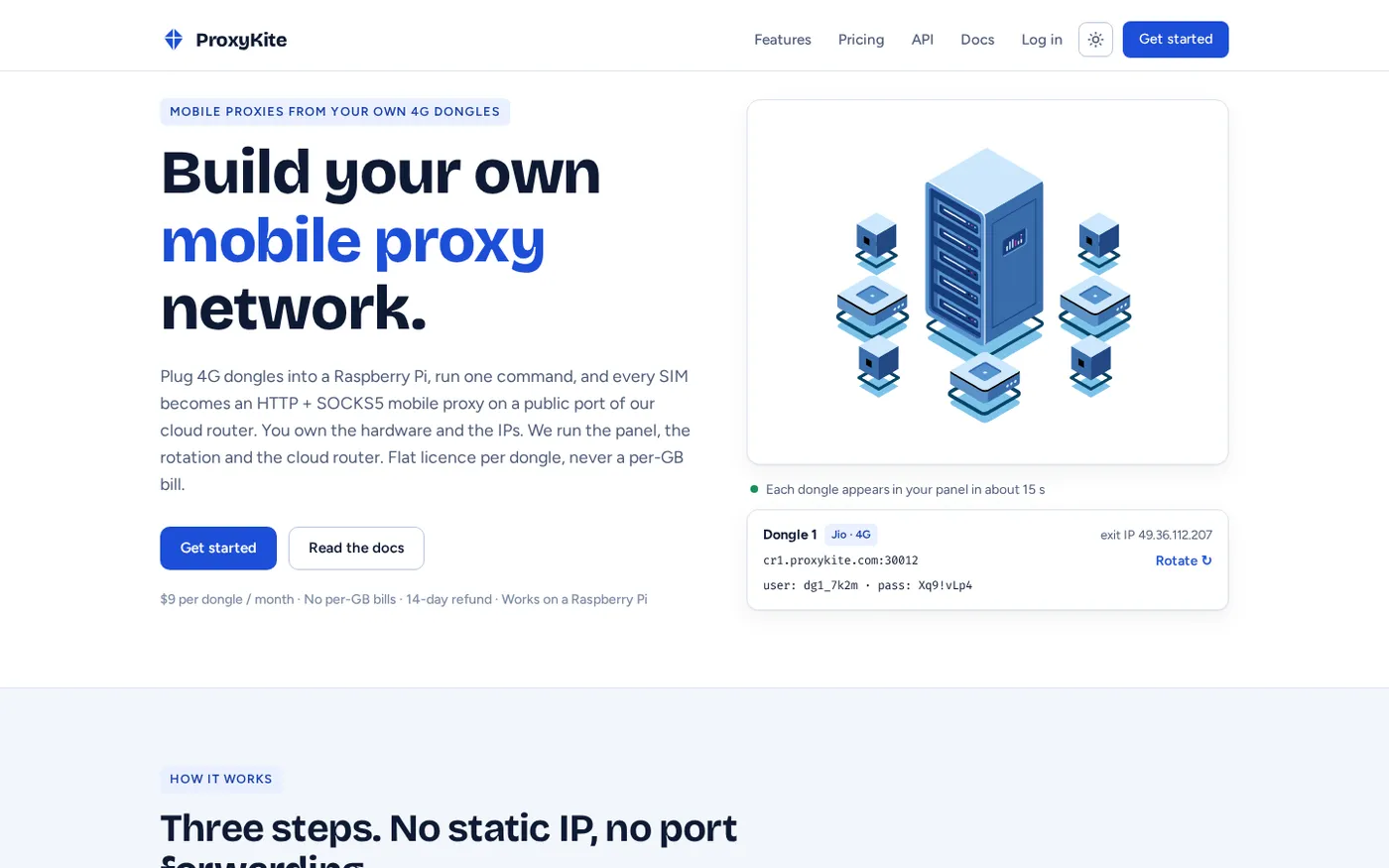
ProxyKite’s software licence is US$9 per active dongle per month, with no per-GB software charge because traffic uses the customer’s own SIM data plan. The software supports HTTP and SOCKS5 access, sub-users, quotas, expiry dates, white-label presentation, API workflows, and cloud routing without static IP or inbound port forwarding. Fleets of 50+ dongles can request volume pricing through contact; the reseller model shows how the customer-facing workflow fits together. Do not publish an unconfirmed discount.
Success looks like a one-page offer that a technical buyer can forward to a colleague without adding an explanation. Keep customer pricing separate from your software cost: add SIM data, hardware, support, payment fees, and your margin before setting a retail price.
Step 3: Start with agencies and technical teams
Why this matters: a small number of relevant conversations can teach you more than a large untargeted advertising campaign.
Work through your 25-prospect list in small batches. For each prospect:
- Read the company’s service page and identify one workflow that matches your offer.
- Find the person responsible for data collection, ad operations, QA, or infrastructure.
- Send a short, specific message that asks whether the problem exists.
- Offer a short call or a defined paid pilot only after confirming the use case.
- Record the answer, next step, required region, expected concurrency, and objections.
A practical first message is:
Subject: Mobile connection for [specific workflow]

Hi [name],

I saw that [company] works on [specific authorised workflow]. I run a small mobile-proxy service for teams that need [region or integration detail].

Would a separate HTTP/SOCKS5 connection with [verified capability] help with that workflow? If so, which regions, concurrency, rotation behaviour, and support window would you need?

If it is not relevant, I will not follow up.

Regards,
[name]
Keep the message truthful and easy to decline. If you use commercial email, check the rules for every recipient’s country. For US commercial email, the Federal Trade Commission’s CAN-SPAM guide explains requirements including accurate sender information, truthful subject lines, a physical postal address, and an opt-out method. A business-to-business recipient is not automatically outside those rules.
Success looks like five useful conversations, not a large sent count. Ask each interested prospect what would make them switch, what they need to test first, and who approves the purchase.
Step 4: Use communities and marketplaces with permission
Why this matters: technical communities can put you in front of qualified buyers, but promotional behaviour can remove trust faster than it creates leads.
Join communities where your chosen buyer already discusses QA, ad verification, public-data collection, SMM operations, or proxy infrastructure. Spend time answering technical questions before promoting anything. When a community allows commercial posts, disclose that you own the service, explain the permitted use case, and link to the one page that answers the basic questions.
For forums and chat groups, use this sequence:
- Read the posting and self-promotion rules.
- Ask a moderator whether a short product post is allowed if the rules are unclear.
- Publish a useful explanation or setup lesson, not a repeated sales slogan.
- Reply to questions in public when the answer helps others.
- Move account-specific details to a private support channel only after the person asks.
Reddit’s official spam guidance prohibits repeated or unsolicited mass engagement and recommends authentic contributions, careful frequency, and checking each community’s rules. Apply the same discipline on other forums even when their wording differs.
Marketplaces and partner directories can provide reach, but review the commercial terms first. Check who owns the customer relationship, who handles support, how commissions work, whether you can set quotas, and whether the channel permits your use cases. A marketplace listing should send qualified buyers to a defined offer, not hide important limits behind a sales chat.
Success looks like one or two channels where people ask relevant questions and you can respond consistently. Leave channels that produce only price shoppers or requests outside your acceptable-use policy.
Step 5: Build a one-page site with clear terms
Why this matters: prospects need somewhere credible to verify your offer after a conversation, and search visitors need a page that answers the query without forcing a call.
Use this page order:
- Headline: name the buyer and job, such as mobile proxy access for authorised ad verification teams.
- How it works: your dongles and SIMs connect to your control box; cloud routing exposes the customer-facing endpoint.
- Offer: regions, protocols, rotation choices, quotas, authentication, and support.
- Delivery: show the connection formats and link to the ProxyKite proxy-format documentation.
- Trust details: business identity, support contact, billing terms, privacy notice, refund policy, and acceptable use.
- Contact action: ask for the buyer’s use case, region, concurrency, and desired start date.
Do not publish a self-serve signup or open-ended no-cost access if you cannot screen and support it. A contact-led process is enough for your first customers. If you run a pilot, put its duration, ports, quota, support scope, payment, and renewal terms in writing before enabling access.
Use one page per real buyer problem, not dozens of near-identical pages stuffed with locations and keywords. Google’s Search spam policies specifically warn against keyword stuffing, doorway abuse, link spam, and scaled low-value content. Write for the person who must decide whether your service fits their workflow.
Success looks like a prospect can answer five questions without contacting you: What is it? Is my use allowed? What do I receive? What does it cost? How do I get help?
Step 6: Run a controlled pilot and screen customers
Why this matters: a bounded pilot lets a serious buyer verify integration while protecting your SIM data, IP reputation, and support time.
Treat a pilot as a small commercial engagement, not unlimited access dressed up as marketing. Before issuing credentials, collect:
- The person or business responsible for the account.
- The intended workflow and the customer’s authority to perform it.
- Required region, protocol, concurrency, rotation behaviour, and data estimate.
- A support email and an escalation contact.
- Agreement to your terms and acceptable-use policy.
- The pilot’s ports, quota, expiry date, price, and renewal decision.
Use separate credentials or sub-users for each customer. Apply a daily, weekly, or monthly bandwidth limit before delivery. Keep the customer’s proxy assignment, access method, quota, and expiry date in your records. ProxyKite supports those sub-user, quota, expiry, and traffic-insight workflows, so you can make the pilot repeatable.
Decline or pause requests involving fraud, carding, account takeover, credential stuffing, spam, bulk SMS, unauthorised scanning, denial-of-service traffic, or bypassing a platform ban. Vague requests for “unlimited” access, large numbers of accounts, or secrecy about the target are reasons to ask for more information, not reasons to remove your controls. Keep your policy and service terms visible.
Success looks like a customer who completes a defined test, understands the limits, and either renews or gives a specific reason not to. The goal is a reliable reference process, not the highest possible pilot volume.
Step 7: Make onboarding simple for technical buyers
Why this matters: a customer who can connect in minutes reaches value sooner and creates fewer avoidable support tickets.
Send a short onboarding email with these items:
- The assigned host, port, username, and password through a secure handoff.
- The HTTP and SOCKS5 connection strings in the format the customer requested.
- A link to the proxy-format guide.
- A safe test command using placeholders:
curl -x 'http://USER:PASSWORD@HOST:PORT' https://api.ipify.org- The quota, expiry date, rotation method, and support contact.
- A reminder that a rotation link is a secret and must not be pasted into public tickets or client-side code.
Offer common export styles such as host:port:user:pass, user:pass@host:port, and CSV when they match the customer’s tool. Keep credentials out of screenshots and shared documents. If the buyer needs API automation, send them to the relevant documentation after the basic connection works.
Success looks like the customer can run one authorised request, identify which credential was used, and tell you the exact error if the test fails. Ask for a short confirmation rather than making the customer guess whether setup is complete.
Step 8: Keep the first customers
Why this matters: a customer who receives clear support and predictable account handling is more likely to renew and refer a similar buyer.
Set a simple operating rhythm:
- Check traffic insights and quota alerts on a schedule you can maintain.
- Tell the customer before a quota or expiry date stops access.
- Keep a record of region, rotation, credential, and sub-user changes.
- Answer with the exact next diagnostic step instead of a generic “try again”.
- Ask whether the current plan still matches the workflow before renewal.
- Request permission before using a customer’s name, logo, or result in marketing.
ProxyKite includes live traffic insights, bandwidth limits, website rules, webhooks, Telegram alerts, exports, sub-users, white-label options, and a REST API. Use those controls to make account changes repeatable, but keep the customer relationship and support record in your own business.
Success looks like a renewal checklist that takes minutes, not a fresh manual setup for every billing cycle. Referrals should come from a useful experience, not from asking customers to send unsolicited promotional messages.
Verify your first 10-customer funnel
Review this scorecard every week:
- Which buyer group produced the most relevant conversations?
- How many prospects described a matching authorised job?
- How many asked for a region or protocol you can actually deliver?
- How many received an offer with a quota, expiry, and support scope?
- How many started a paid pilot?
- Which setup question appeared more than once?
- Which support issue consumed the most time?
- Which customers reached renewal or referred a similar team?
Track the answers in a small table with columns for prospect, use case, region, stage, next action, customer owner, quota, and result. Change one part of the funnel at a time. If replies are poor, improve the niche or message before buying more hardware; if pilots stall at setup, improve the docs before increasing outreach.
Troubleshooting
Prospects view the page but do not contact you
Replace broad claims with one buyer, one job, one example workflow, and one contact question. Put regions, protocols, quotas, and support expectations above the fold so the right prospect can self-qualify.
Everyone asks for unlimited access
Your offer may be too vague. State the quota, concurrency, rotation behaviour, and support boundary, then ask what workload they are actually planning. A defined plan is easier to price and safer to support.
A pilot customer cannot connect
Confirm the host, port, username, password, protocol, and whether their client expects HTTP or SOCKS5. Ask for the exact error and a timestamp, then test the same format with a clean authorised client. Do not paste a customer’s live credentials into a public ticket.
A community removes your post
Read the rule that was applied, acknowledge it, and ask the moderator whether an educational post or approved listing is permitted. Do not repost the same promotion from another account.
A prospect requests prohibited work
Do not negotiate around the policy. Decline clearly, record the reason, and keep the prospect out of your customer funnel. A smaller list of accountable customers is easier to operate than a larger list built on risky requests.
FAQ
How do I get my first customers for a proxy business?
Choose one buyer group, make a list of relevant businesses, and start direct conversations about an authorised workflow. Support that outreach with a one-page offer, a defined paid pilot, and technical onboarding that shows exactly how the customer will connect.
Where can I sell proxies online?
Start with your own website, direct agency outreach, relevant technical communities, partners, and marketplaces that permit your use case. Read each community or marketplace rule first, disclose your relationship to the service, and avoid repeated unsolicited promotion.
Should I let prospects test mobile proxies?
You do not need open-ended no-cost access to validate demand. Use a controlled pilot with a named customer, defined ports, a quota, an expiry date, acceptable-use terms, and a clear renewal decision.
How should I screen proxy customers?
Record who controls the account, what authorised job they will perform, which region and concurrency they need, and which support contact is responsible. Decline fraud, credential attacks, spam, bulk SMS, scanning, denial-of-service traffic, and ban evasion before issuing access.
What should I send a new proxy customer?
Send the assigned connection details securely, the HTTP/SOCKS5 format they requested, a placeholder test command, the quota and expiry, the rotation instructions, and your support contact. ProxyKite’s documentation covers common connection strings and exports so a technical buyer can integrate without a long back-and-forth.