Is it legal to run a mobile proxy farm? Usually, the equipment itself is not the deciding factor; the answer depends on your carrier agreement, SIM ownership, customer activity, and local rules. Before you sell access, check each of those areas and build a simple record-and-abuse process.
This is a compliance checklist, not legal advice. Telecom, privacy, consumer-protection, and criminal laws differ by country. If you are deploying a large fleet or selling access across borders, have a local telecom or technology lawyer review your plan.
Short answer: what makes a farm lawful or risky?
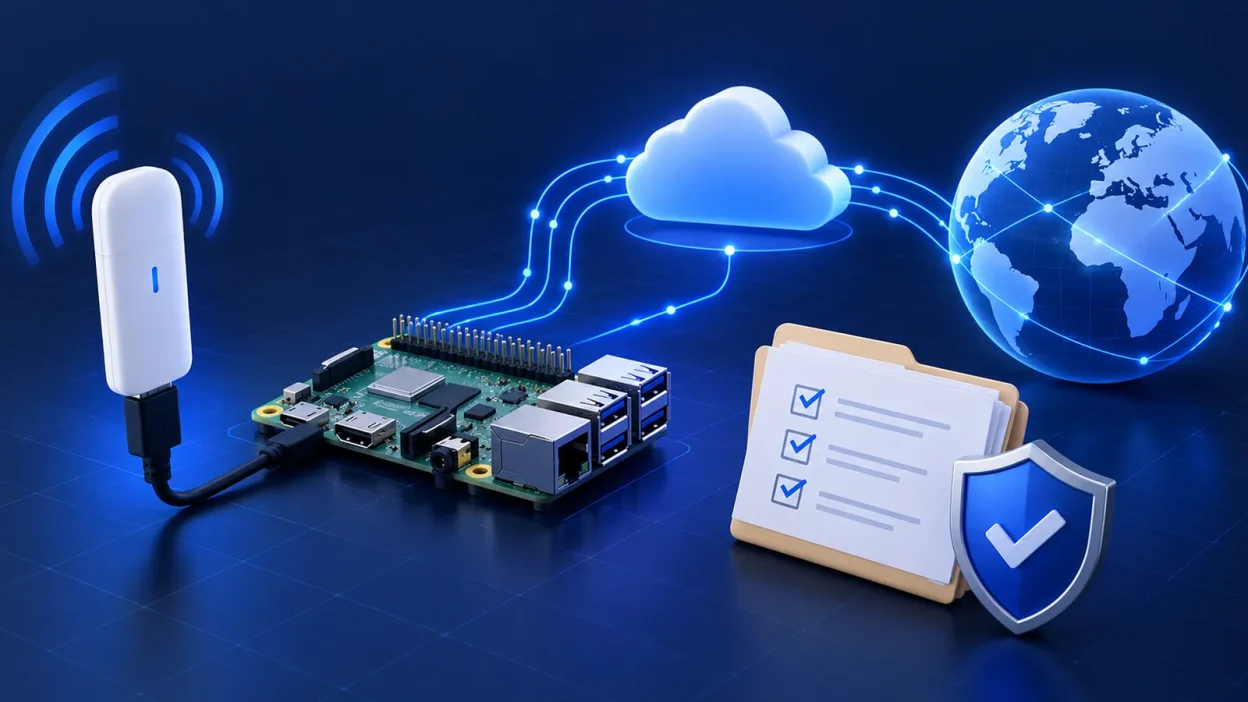
A mobile proxy farm is a group of phones or cellular USB dongles whose mobile connections are exposed as proxies. A Raspberry Pi or Linux box can manage the connections, while customers use the resulting HTTP or SOCKS5 endpoints for legitimate work such as ad verification, website quality assurance, price monitoring, or social media management for accounts they own or manage.
That description does not make every deployment lawful. Treat the question as four separate checks:
| Check | What you need to confirm | Why it matters |
|---|---|---|
| Network plan | The carrier allows the intended device, traffic, and commercial use | A normal consumer plan may have restrictions that a business or machine-to-machine plan does not |
| SIM identity | Each connection is obtained and registered lawfully | Incorrect or borrowed identity information creates a separate compliance problem |
| Customer activity | Your terms and onboarding exclude unlawful or abusive use | Your subscriber account and IPs may be the first place an investigation or abuse report reaches |
| Operations | You can identify, respond to, and document misuse | A written process helps you act consistently and answer legitimate notices |
The safest starting point is not “proxies are legal.” It is “I can show why this connection, this customer, and this use are permitted.”
Carrier terms: read the data plan
Your first contract is with the mobile carrier, not with your proxy customer. Read the plan’s acceptable-use policy, device restrictions, tethering language, resale terms, data caps, and any clause about automated or commercial traffic.
Look for answers to these questions:
- Is the SIM permitted in a USB modem, router, or other machine rather than only in a handset?
- Does the plan permit a business to route traffic for its own systems or for third parties?
- Are resale, redistribution, tethering, or hosting services restricted?
- Are there limits on the number of connections, monthly usage, or the kind of traffic allowed?
- What notice or suspension process applies if the carrier receives an abuse complaint?
Do not rely on a sales-page phrase such as “unlimited data.” The full plan terms control, and a plan can change after renewal. Ask the carrier for written confirmation if the wording is unclear. Keep the plan name, version or date, and the answer in your operating records.
For hardware planning, our guide to 4G proxy farm setup covers dongles, power, hubs, and the Linux box. Hardware that works technically can still be the wrong choice if the SIM plan does not allow the intended use.
SIM ownership and KYC
Use SIMs that you acquired through a lawful channel and that are registered to the correct person or business. Do not use connections registered in another person’s name, buy “pre-verified” SIMs with unclear provenance, or ask workers to obtain SIMs for a hidden purpose. Those shortcuts make ownership and authority difficult to prove.
For each SIM, keep a private inventory containing:
- the carrier and plan name;
- the SIM or connection identifier, stored with appropriate access controls;
- the legal owner or business account;
- the date and channel of activation;
- the dongle or device to which it is assigned; and
- the documents or account reference that establish lawful activation.
Do not publish this inventory or place identity documents in a shared dashboard. Limit access, define a retention period, and delete documents when you no longer need them unless a law, contract, dispute, or valid request requires preservation.
In India, the Department of Telecommunications’ digital KYC instructions describe identity and address-document checks, live-photo verification, activation checks, and tele-verification in the stated process. The current carrier process and applicable instructions should be your source of truth. The government’s Sanchar Saathi service also provides a way for people to review mobile connections issued in their name. Use it as an ownership check, not as a substitute for legal advice.
You are not selling permission for anything
A proxy is a routing tool. Your customer’s intended use still matters. A proxy can support legitimate ad verification or price monitoring, but the same endpoint can be used for fraud, unauthorized access, spam, credential attacks, or attempts to evade a platform’s rules. A change of IP address does not make an otherwise unlawful act lawful.
Write an acceptable-use policy in plain language. Prohibit activity that is illegal, abusive, deceptive, or unauthorized. Also prohibit attempts to defeat security controls, send unsolicited bulk messages, access accounts without permission, or use the service to attack systems. Do not make promises such as “undetectable” or “never banned”; they are not compliance controls and cannot be guaranteed.
Your customer contract should explain:
- what access is being provided and what it is not;
- who may use the account;
- which uses are prohibited;
- how a customer can report an issue;
- when you can suspend or terminate access; and
- how you handle valid legal, carrier, or abuse notices.
This does not transfer every legal risk to the customer. It gives you a clear standard for screening and enforcement. It also shows customers that the farm is operated as a service with boundaries rather than as an anonymous open relay.
Terms, logs, and abuse handling
You need enough information to answer “which customer was assigned this endpoint at this time?” You do not automatically need to collect the full content of every request. In fact, collecting more personal data than you need can create additional privacy and security obligations.
A practical minimum record might include:
| Record | Example purpose |
|---|---|
| Customer identity and contact | Tie an account to a real person or business, subject to local rules |
| Assigned proxy, port, or dongle | Identify the network path used at the relevant time |
| Allocation and release timestamps | Resolve which customer had access during a reported event |
| Account status and actions | Show warnings, suspensions, or termination decisions |
| Abuse report and response | Keep the complaint, your verification steps, and the outcome together |
Set the retention period with local legal advice. Protect the records from ordinary customer access, restrict administrator access, use encryption where appropriate, and make sure timestamps have a known timezone. A log that cannot be interpreted six months later is not much help.
Create an abuse inbox before launch. When a credible report arrives, preserve the relevant account and allocation records, acknowledge the report, assess whether the activity violates your rules, and suspend access when your policy allows it. Escalate emergencies and formal legal requests through your lawyer or the relevant authority. Do not promise a reporter that you will disclose private customer information without checking the applicable law.
ProxyKite’s Terms are a useful reference point for the service relationship, but you still need to review your own carrier agreements, customer contract, privacy notice, and local obligations.
India-specific checks
If your farm operates in India, make India’s telecom and identity requirements part of the launch checklist. The exact answer depends on the carrier, plan, device, use case, business structure, and the location of your customers.
1. Confirm the subscriber record
Keep every SIM under the correct subscriber or business account. Check the connections associated with your identity and remove anything you did not authorize. Do not treat a large number of connections as proof that a proxy business is approved; it only shows that connections exist.
2. Confirm the plan and device use
Ask the carrier whether the specific plan permits the dongle, routing, commercial operation, and traffic pattern you intend to run. Save the response. If the carrier directs you to a business plan, machine-to-machine plan, or special approval, obtain that approval before putting customers on the endpoints.
3. Treat SMS as a separate compliance issue
A proxy farm may expose an SMS inbox for carrier notices and operational alerts. That does not turn an ordinary SIM into a bulk-messaging service. If you send commercial messages, review the Telecom Regulatory Authority of India’s UCC and commercial-communication guidance, including the requirements and processes it points senders and telemarketers toward.
Keep the SMS inbox for your own operational use, and never use the SIMs for promotional or unsolicited messages.
4. Check business and data obligations
Ask a local professional about business registration, invoicing and taxes, consumer terms, cross-border sales, privacy notices, and any data-protection duties created by your logs or customer verification. A software licence or cloud router does not remove those obligations. For larger fleets, get this review before you advertise rather than after the first complaint.
A checklist before you sell access
Run through this list for each country and carrier combination:
- Map the setup. List the physical location, carrier, plan, SIM owner, device, upstream connection, and customer-facing service.
- Get carrier approval. Save the current plan terms and any written answer about modem use, routing, resale, and commercial traffic.
- Verify ownership. Match every SIM to the correct person or business record. Remove unknown or borrowed connections.
- Define legitimate uses. Name the supported use cases, such as ad verification, QA, public-page price monitoring, or managed social accounts.
- Write the customer rules. Publish prohibited uses, suspension rights, reporting channels, and a response process.
- Use controlled access. Require authentication or an allowlist. Do not expose an unauthenticated open proxy.
- Record allocations. Store the customer-to-endpoint mapping and timestamps needed to investigate a report.
- Prepare an abuse playbook. Decide who receives reports, what evidence you review, when you suspend access, and when you obtain legal advice.
- Review privacy. Collect the minimum data, restrict access, document retention, and tell customers what you store.
- Recheck after changes. Repeat the review when you change carrier, plan, country, hardware, customer type, or messaging use.
If you are still choosing the architecture, read how to build your own mobile proxy with 4G and Raspberry Pi before ordering a large batch of equipment. It is cheaper to settle the carrier and ownership questions before the hardware is installed.
For a resale operation, ProxyKite provides software and cloud routing for your own dongles and SIMs; it does not sell the mobile connections themselves. Contact the ProxyKite team if you want to discuss a fleet plan and the operating model before deployment.
Common mistakes
Assuming a proxy is automatically legal
A proxy is neutral technology, but the carrier contract and customer activity are not neutral. “Everyone does it” is not evidence that your plan permits it.
Registering SIMs through someone else
The person or business on the subscriber record should be the party that actually controls the connection. Borrowed identity, informal SIM sourcing, and undocumented ownership make a lawful setup difficult to demonstrate.
Collecting no records at all
Privacy does not mean keeping nothing. Without an allocation record, you cannot answer basic abuse questions or apply your own policy consistently. Collect the minimum useful metadata and protect it.
Treating SMS access like an unrestricted messaging channel
Reading carrier notices on your own SIMs is different from sending unsolicited commercial messages. Check the telecom rules for the country and message type before enabling SMS features.
Writing rules but never enforcing them
An acceptable-use policy is only useful if customers can report abuse and you take proportionate action. Test the inbox, document a sample decision, and make sure an operator can suspend the affected access quickly.
FAQ
Are mobile proxies legal?
Mobile proxy technology is not a universal legal exemption or a universal offence. Legality depends on the network plan, SIM and device rules, customer activity, and the laws where the farm and customer operate.
Is it legal to sell mobile proxies?
It can be, if you have the right to use and route the connections and you comply with applicable business, telecom, privacy, and customer-use rules. Selling access does not give customers permission to commit fraud, access systems without authorization, send spam, or violate a platform’s terms.
Do SIMs need to be in my name?
They should be obtained and registered under the correct person or business identity, using the carrier’s required verification process. The exact KYC rules vary by country, so do not use informal or borrowed registrations as a workaround.
Should a proxy farm keep browsing logs?
Keep the minimum records needed to operate the service, investigate abuse, and meet valid legal obligations. Customer-to-endpoint assignments and timestamps may be useful without storing the full content of every request; choose retention and access controls with local privacy advice.
Can I run a farm on a normal consumer data plan?
Only if the plan’s terms allow the device, traffic, commercial use, and any resale or routing involved. Ask the carrier for a written answer when the terms are unclear, and keep that answer with the plan record.